
Key Takeaway: About 95% of the copper in your blood is safely bound to a protein called ceruloplasmin. The remaining 5% circulates as "free" copper. Research has linked excess free copper to oxidative stress, while bound copper is delivered to cells in a controlled way. When it comes to supplementation, the form of copper you take may matter as much as the amount.
Not all copper is the same
Most conversations about copper focus on how much you need. But a growing body of research suggests that the form of copper in your body -- and in your supplement -- may be just as important as the dose.
The distinction comes down to two categories: bound copper and free copper. They behave differently in the body, are transported by different mechanisms, and carry different risk profiles.
What is bound copper?
Bound copper refers to copper that is attached to ceruloplasmin, a protein synthesized in the liver. This represents approximately 95% of the copper circulating in your blood (Linder MC, Hazegh-Azam M, Am J Clin Nutr, 1996; PubMed).
Ceruloplasmin delivers copper to cells in a controlled manner. It also functions as a ferroxidase -- an enzyme that helps convert iron from one form to another, allowing it to enter circulation. This is one reason copper and iron metabolism are closely connected (Osaki S et al., J Biol Chem, 1966; PubMed). In nutritional terms, copper contributes to normal iron transport in the body.
When cells need copper, they extract it from ceruloplasmin through specific receptors. The process is regulated and targeted.
What is free copper?
Free copper -- also called non-ceruloplasmin copper -- makes up the remaining ~5% of circulating copper. It is loosely bound to albumin, amino acids, and other small molecules.
Unlike ceruloplasmin-bound copper, free copper can cross the blood-brain barrier more readily. In healthy individuals, this fraction is small and manageable. But when the ratio shifts -- either from excess free copper or insufficient ceruloplasmin -- researchers have observed differences worth understanding.
Source: Squitti R et al. "Non-ceruloplasmin copper distinguishes a distinct subtype of Alzheimer's disease." Curr Alzheimer Res. 2016;13(12):1318-1327. PubMed
Why does the distinction matter?
Research on free copper and oxidative stress
One area researchers study is the relationship between elevated free copper and oxidative stress. As a nutrient, copper itself contributes to the protection of cells from oxidative stress -- which is part of why how the body handles it is studied so closely. Several observational findings illustrate why the free-versus-bound balance draws attention:
- Meta-analyses report that non-ceruloplasmin copper levels in serum tend to be higher in some patient groups compared to healthy controls (Squitti R et al., 2016; PubMed).
- Ceruloplasmin fragmentation has been observed in serum in some study populations, which researchers suggest may be linked to free copper deregulation (Squitti R et al., Int J Alzheimers Dis, 2009; PMC).
- Cerebrospinal fluid ceruloplasmin levels have been examined as a marker in research on brain ageing (Diouf I et al., Neurobiol Aging, 2020; PMC).
Important note: These studies are observational. They examine associations between copper metabolism and laboratory markers. They do not show that any supplement prevents, treats, slows, or affects any disease, and nothing in this article should be read that way. If you have a diagnosed condition or any concern, speak with a healthcare professional.
The iron connection
Free copper can participate in Fenton reactions -- a chemical process where iron and copper generate reactive free radicals. Ceruloplasmin-bound copper does not participate in these reactions. In fact, ceruloplasmin helps limit them by converting iron to a more stable form (Gutteridge JM, Chem Biol Interact, 1985; PubMed). It is one more illustration of why how copper is carried -- not just how much there is -- shapes the picture.
Comparison: free copper vs bound copper
| Free copper | Bound copper | |
|---|---|---|
| Also called | Non-ceruloplasmin copper | Ceruloplasmin-bound copper |
| Percentage in blood | ~5% | ~95% |
| Carrier | Albumin, amino acids | Ceruloplasmin protein |
| Crosses blood-brain barrier | More readily | Controlled delivery |
| Role | Short-term transport | Primary copper delivery to cells |
| In excess | Associated with oxidative stress in studies | Safely regulated |
| Measured by | Serum copper minus ceruloplasmin-copper | Ceruloplasmin blood test |
Common copper supplement forms compared
The NIH Office of Dietary Supplements notes that no studies have directly compared the bioavailability of copper from different supplement forms (NIH ODS). However, based on available research and chemical properties:
| Form | Type | Estimated absorption | Notes |
|---|---|---|---|
| Copper oxide | Inorganic | <10% | Cheapest form. Poorly absorbed. Some studies report minimal bioavailability. |
| Copper sulfate | Inorganic salt | 20-50% | Used in research settings. Can cause GI irritation. |
| Copper gluconate | Organic salt | Moderate | Widely used in multivitamins and food fortification. Proven safety record. |
| Copper bisglycinate | Amino acid chelate | 30-60% | Best GI tolerance among common forms. Copper bonded to glycine molecules. (PMC) |
| Sodium copper chlorophyllin | Plant-derived | Under investigation | Copper bound to chlorophyll-derived molecule. Water-soluble. Used orally for 50+ years. (Linus Pauling Institute) |
What is sodium copper chlorophyllin?
Sodium copper chlorophyllin (SCC) is a semi-synthetic compound derived from chlorophyll -- the green pigment in plants. During its production, the magnesium atom at the center of the chlorophyll molecule is replaced with copper, and the compound is made water-soluble (Linus Pauling Institute, Oregon State University; Link).
SCC has a long history of use, going back more than 50 years in topical and internal applications, without serious reported side effects. A study published in PNAS reported that supplementation with SCC (100 mg three times daily for 4 months) was associated with a reduction in a urinary biomarker of aflatoxin-related DNA damage in a high-risk population (PNAS). This is research on a specific biomarker and is not a health claim for any supplement.
SCC can be derived from several plant sources. Mulberry leaves are one common source -- the chlorophyll is extracted, then saponified and copper-substituted to produce the final compound.
Because the copper in SCC is already bound to an organic molecule, it represents a fundamentally different delivery mechanism than inorganic copper salts like copper sulfate or copper oxide.
Frequently asked questions
What is the difference between free copper and bound copper?
Bound copper is attached to the protein ceruloplasmin and makes up about 95% of copper in the blood. Free copper (non-ceruloplasmin copper) is loosely bound to albumin and small molecules and makes up about 5%. Research has linked excess free copper to oxidative stress.
Is free copper dangerous?
In small amounts, free copper is a normal part of copper transport. Researchers pay attention to the free-to-bound ratio, and more research is needed to understand the full picture. If you are concerned about your copper status, the right step is testing and a conversation with a healthcare professional.
Which form of copper supplement is best?
There is no definitive answer. The NIH notes that no studies have directly compared bioavailability across forms. Copper bisglycinate offers good GI tolerance, while sodium copper chlorophyllin delivers copper in a plant-derived bound form. The best choice depends on individual needs and medical guidance. For a detailed comparison of all forms, see our guide to copper supplement forms.
Can I test my free copper levels?
Yes. Free copper is calculated by measuring total serum copper and subtracting ceruloplasmin-bound copper. Ask your doctor for both a serum copper test and a ceruloplasmin test.
Does the form of copper in a supplement affect how my body uses it?
The chemical form determines how copper is absorbed and transported. Inorganic forms (oxide, sulfate) release copper ions directly. Chelated forms (bisglycinate) and plant-derived forms (SCC) deliver copper bound to other molecules, which may affect absorption pathways.
A note on copper form and supplementation
The distinction between free and bound copper in the body parallels an important question in supplementation: does the form of copper you take influence how your body handles it?
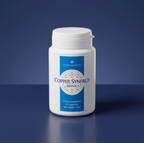
CSR-01 by Copper Synergy uses 100 mg of sodium copper chlorophyllin from mulberry leaves -- a plant-derived form where copper is already bound to a chlorophyll-derived molecule. The formula also includes vitamin A (800 mcg) and vitamin C (80 mg). As recognised nutrients, copper contributes to normal energy-yielding metabolism, to the normal functioning of the nervous system, to the normal function of the immune system, to the maintenance of normal connective tissues, to normal iron transport in the body, and to the protection of cells from oxidative stress; vitamin C and vitamin A also contribute to the normal function of the immune system.
Important: Copper supplementation is not appropriate for individuals with Wilson's disease. Consult your healthcare professional before starting any copper supplement.
Sources:
- Linder MC, Hazegh-Azam M. (1996). "Copper biochemistry and molecular biology." Am J Clin Nutr. PubMed
- Osaki S et al. (1966). "The role of ceruloplasmin in iron metabolism." J Biol Chem. PubMed
- Squitti R et al. (2016). "Non-ceruloplasmin copper in Alzheimer's disease." Curr Alzheimer Res. PubMed
- Squitti R et al. (2009). "Ceruloplasmin fragmentation in Alzheimer's disease." Int J Alzheimers Dis. PMC
- Diouf I et al. (2020). "CSF ceruloplasmin predicts cognitive decline." Neurobiol Aging. PMC
- Gutteridge JM. (1985). "Inhibition of the Fenton reaction by caeruloplasmin." Chem Biol Interact. PubMed
- NIH Office of Dietary Supplements. "Copper -- Health Professional Fact Sheet." Link
- Linus Pauling Institute. "Chlorophyll and Metallo-Chlorophyll Derivatives." Link
- Egner PA et al. (2001). "Chlorophyllin intervention reduces aflatoxin-DNA adducts." PNAS. Link
- Bala S et al. (2021). "Relative bioavailability of organic bis-glycinate bound copper." PMC. Link
Wondering where your copper intake stands?
Take the Copper Nutrition Quiz to learn more.
Related research
Continue exploring this topic:
Frequently asked questions
What is the difference between free and bound copper?
Most copper in your blood is bound to ceruloplasmin and used safely. Free (unbound) copper is not carried by ceruloplasmin and, in excess, has been studied in relation to oxidative stress.
Why does the form of copper matter?
How copper is carried and absorbed affects how your body uses it. A well-bound, bioavailable form may be used more effectively than a poorly absorbed one, sometimes more than the dose on the label suggests.
How do I know my copper balance?
A blood test for serum copper and ceruloplasmin lets a professional estimate your free-copper status. This article is educational and not a substitute for testing.


